Almost every final year student in Nigeria hits the same wall in the same week. The project has been assigned, the supervisor has said "bring me a proposal," and you are sitting there wondering what a proposal even is, let alone how to write one. So you do the natural thing: you search "how do I start writing my final year project" and you land somewhere like here. Good. This is the right place to start, because the proposal is genuinely where the project begins, and getting it right makes everything after it easier.
A project proposal is, in plain terms, a short document that convinces your supervisor of three things: that your topic is worth studying, that it is actually doable in the time you have, and that you have a sensible plan to do it. It is usually three to eight pages. Get it approved and the rest of your project flows from it. Skip it or rush it and you will spend the whole session rewriting Chapter One.
How do I start writing my final year project?
You do not start by writing chapters. You start by getting a topic approved and a proposal accepted. Trying to write Chapter One before you have a clear, approved direction is the single biggest reason students stall for months. Here is the order that actually works.
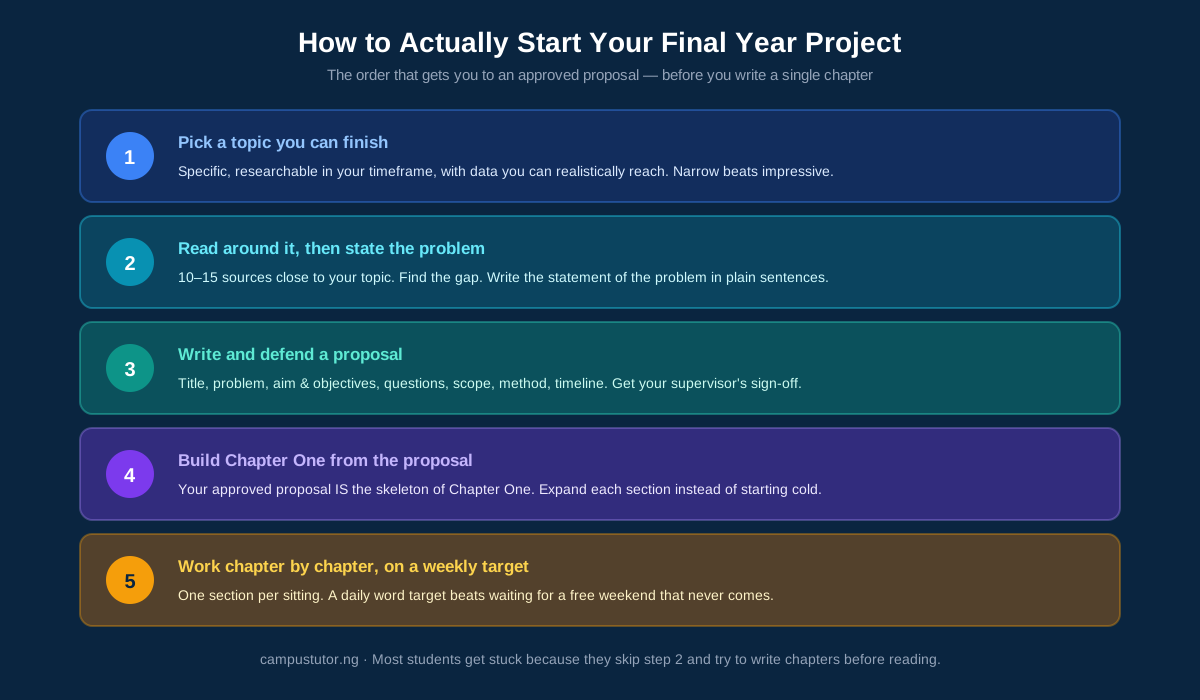
Notice that the proposal sits at step three, after you have chosen a topic and done some reading, and before you write any chapters. That position is the whole point. The proposal is the bridge between "I have a vague idea" and "I am writing my project."
How to write a project topic that gets approved
Half of proposal trouble starts at the topic. A weak topic cannot be rescued by good writing. The students whose proposals get approved on the first or second try almost always pick a topic that is specific, researchable, and locally grounded. A strong Nigerian project topic usually names a variable, a population, and a place.
- Too broad: "The impact of social media on students." An entire textbook could be written on this — no examiner will believe you can cover it.
- Better: "The effect of Instagram use on the study habits of 300-level Mass Communication students in [your institution]." A variable (Instagram use), a population (300-level Mass Comm students), and a place (your school).
- Too broad: "Poverty in Nigeria." Nobody can collect that data.
- Better: "The effect of microfinance loans on the income of market women in [a named market] between 2024 and 2026."
What goes into a project proposal?
A Nigerian project proposal is essentially a condensed, forward-looking version of your Chapter One, plus a plan and a timeline. The exact sub-headings vary by department, but almost every proposal contains these seven components.
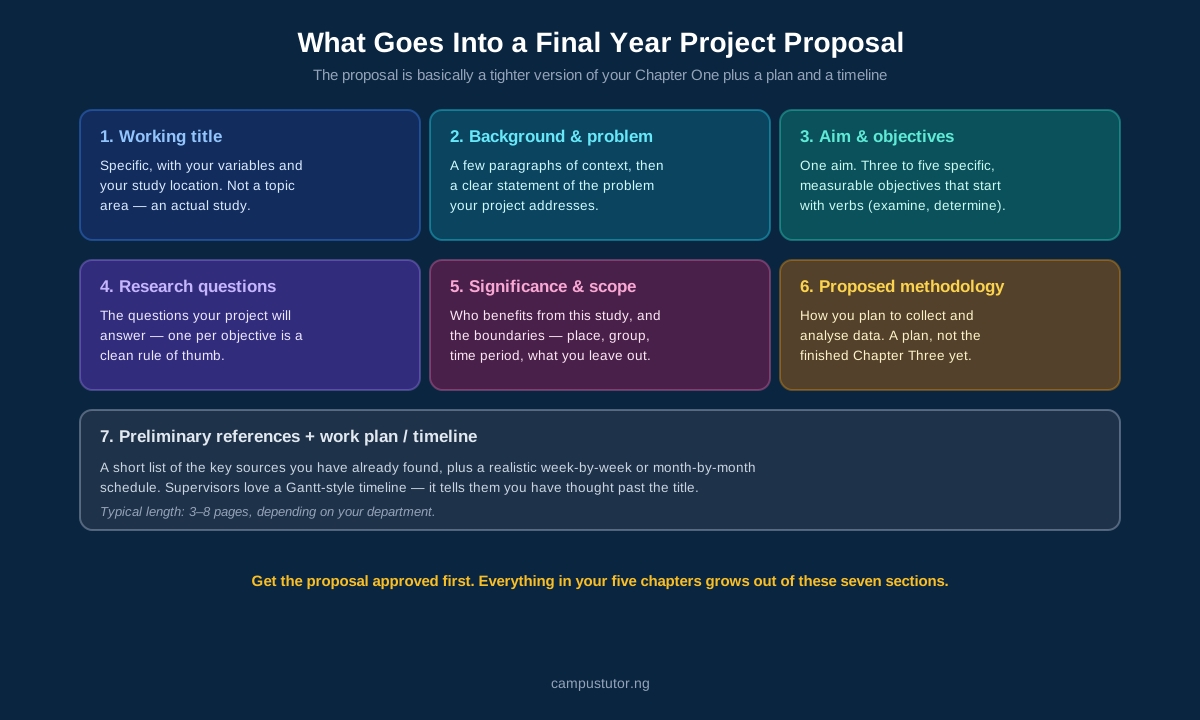
- Working title: specific, with your variables and study location. It can change later, but make it a real study, not a topic area.
- Background and statement of the problem: a few paragraphs of context, narrowing to a clear statement of what is wrong, missing, or unresolved.
- Aim and objectives: one aim and three to five measurable objectives, each starting with a verb (examine, determine, assess).
- Research questions and/or hypotheses: usually one research question per objective.
- Significance and scope: who benefits from the study, and the boundaries of what you will and will not cover.
- Proposed methodology: how you plan to collect and analyse your data. This is a plan, not yet your finished Chapter Three.
- Preliminary references and a work plan: a short list of key sources you have already found, plus a realistic week-by-week or month-by-month timeline.
Can you give me an example of a project proposal?
Here is a worked skeleton you can adapt. Imagine a Business Administration student at a Nigerian polytechnic. The point is not to copy the words but to see how the seven components fit together into a coherent argument.
- Working title: "The effect of mobile money agents on the savings habits of petty traders in [named market], [state], 2025–2026."
- Problem: Petty traders in the market handle daily cash but few use formal savings, and existing studies assume this is due to low income, while preliminary observation suggests limited access to nearby agents may be the real barrier.
- Aim: To examine how the presence of mobile money agents affects the savings habits of petty traders in the market.
- Objectives: (1) determine the proportion of traders who save through mobile money agents; (2) examine the relationship between distance to the nearest agent and frequency of saving; (3) identify the main barriers traders report to saving.
- Research questions: one per objective, phrased as questions.
- Significance: findings could guide mobile money providers and cooperative societies on agent placement.
- Scope: 60 traders in one named market, surveyed over four weeks; excludes wholesale traders and online sellers.
- Methodology: descriptive survey design, structured questionnaire, simple random sampling, analysed with frequency tables and chi-square.
- Timeline: Weeks 1–2 finalise instrument and pilot; Weeks 3–4 collect data; Week 5 analyse; Week 6 write up and submit.
That fits on three or four pages, and it gives a supervisor everything they need to say "yes, go ahead", or to tell you precisely what to tighten. A vague half-page "I want to study mobile money" gets sent back. A focused skeleton like this gets approved.
Can ChatGPT write a project proposal?
This is one of the most-searched questions among Nigerian students right now, and the honest answer is: it can produce something that looks like a proposal, but you should not let it write yours wholesale, and here is why.
ChatGPT does not know your market, your department's expectations, your supervisor's pet preferences, or what data you can actually reach. So it generates a generic, plausible-sounding proposal with invented context and, very often, fabricated citations, references to journal articles that do not exist. Supervisors in Nigeria have become extremely good at spotting this, partly because they read fifty proposals a session and the AI ones all sound the same, and partly because they now have AI-detection tools. A proposal that sounds polished but cannot answer a follow-up question is an instant red flag.
Where AI genuinely helps with a proposal is a different set of tasks: sharpening a topic you have already chosen, checking that your objectives line up with your research questions, suggesting how to reword a clumsy problem statement you wrote yourself, or helping you understand a theory you read about but did not fully grasp. Used that way, it is a thinking aid. Used to generate the document, it produces something detectable, undefendable, and usually wrong about your specific context.
If you are weighing the broader question of how much AI tools can and cannot do across the whole project, we go deeper into it in our complete guide to writing your thesis in Nigeria.
What happens after the proposal is approved?
Once your supervisor signs off, the hardest decision of the project is already behind you. Your approved proposal becomes the skeleton of Chapter One: your background, statement of the problem, aim, objectives, questions, significance, and scope are all already drafted, and our guide on how to write Chapter One shows exactly how to expand each one. Your proposed methodology becomes the first draft of Chapter Three. From here, the project is mostly expansion, reading more deeply, collecting your data, and filling out each section, rather than invention.
If you want to see exactly how the approved proposal expands into the full document, our breakdown of the final year project format maps every proposal section to where it lands in the five chapters.
Your supervisor is not asking for a perfect proposal. They are asking for proof that you have a real question, a real plan, and a realistic chance of finishing. Give them that, and they will let you start.— CampusTutor Editorial
Share this article