Nobody sits down in 100 level and thinks seriously about their final year project. By the time it matters, most Nigerian students are already behind. The project deadline is looming, the supervisor is not responding to messages, and the five-chapter document that stands between you and your degree feels like it belongs to a different version of yourself who actually had their life together.
This guide answers the questions Nigerian students are actually searching for. How long does a thesis really take to write? Can you do a PhD thesis in two months? Is 20,000 words enough? What does it cost to get help? Where do you publish when you are done? Real answers, no padding.
How long does a thesis take to write in Nigeria
The honest answer depends on the level and the discipline, but here are realistic numbers that apply to most Nigerian students.
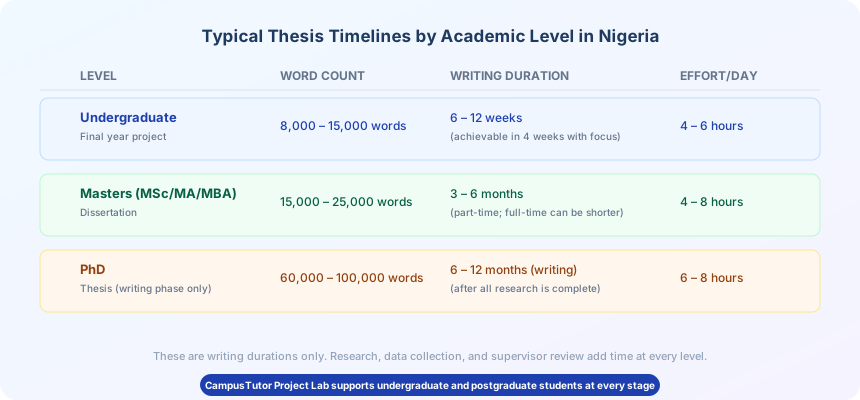
- Undergraduate final year project: 6 to 12 weeks of focused work. This assumes topic approval is in place, data is accessible, and you are treating it as a priority rather than a side activity.
- Postgraduate diploma or PGD dissertation: 8 to 14 weeks, typically shorter in scope than a full masters.
- Masters thesis (MSc, MA, MBA): 3 to 6 months of part-time or focused work. Full-time students with clear supervision can compress this.
- PhD thesis: 2 to 4 years for the research itself. The writing phase alone, assuming all experiments and data collection are complete, typically takes 6 to 12 months.
The reason these timelines feel unachievable to most students is not the writing itself. Writing five chapters is not the hard part, especially once you know the standard final year project format and treat each section as its own small task. The hard part is starting before you feel ready, which almost nobody does voluntarily.
Can you write a PhD thesis in two months
Two months to write a PhD thesis from scratch is not realistic. Two months to write the thesis document if all your research, experiments, and data collection are already complete is possible but extremely demanding.
A PhD thesis in Nigeria typically runs between 60,000 and 100,000 words depending on the discipline and the institution. At a sustainable writing pace of 1,000 to 1,500 words per day, that is sixty to one hundred days of writing, not including revision, supervisor feedback loops, or reformatting. Two months gives you roughly sixty days. It can be done if you are writing full-time with no other obligations, your data is clean, and you are not waiting on supervisor feedback.
The more honest framing is this: two months is probably not enough time to write a PhD thesis to a standard that will pass your viva, but it is enough time to produce a complete draft that your supervisor can work with. Most Nigerian PhD students who finish in the expected timeframe write in a sustained, focused way for six to eight months after data collection is complete.
Is 20,000 words enough for a PhD thesis
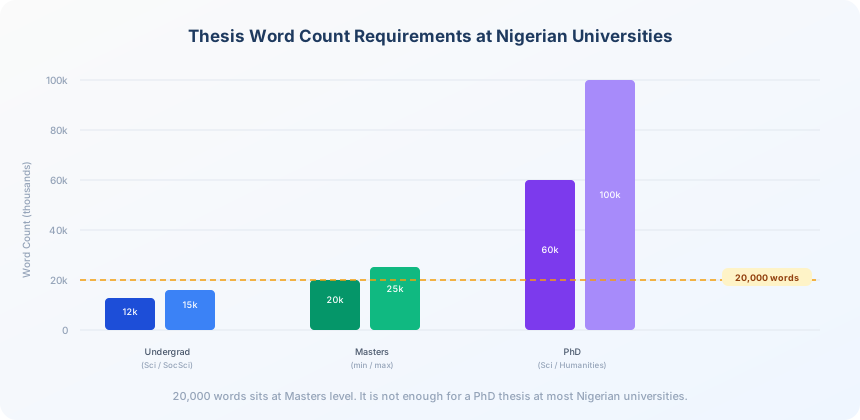
No, not at most Nigerian universities. A typical PhD thesis in Nigeria runs between 60,000 and 100,000 words depending on the discipline. Science and engineering theses tend to sit at the lower end of this range because much of the work is communicated through data, charts, and methodology rather than extended prose. Humanities and social science theses tend toward the higher end.
20,000 words is more in the range of a masters thesis or a strong postgraduate dissertation. If your institution or supervisor has specified a word count, that takes precedence over any general guidance. Always confirm the expected length with your department before you start writing, not after.
What is the cost of writing a thesis in Nigeria
The cost breaks down into a few different categories depending on what kind of help you are looking for.
- Statistical analysis (SPSS, STATA, R): between ₦15,000 and ₦60,000 for a complete analysis depending on the size and complexity of your dataset. This is one of the most legitimate forms of paid thesis support.
- Proofreading and editing: between ₦5,000 and ₦30,000 for a full undergraduate project. Most professional editors charge per 1,000 words.
- Binding and printing: between ₦3,000 and ₦15,000 depending on the institution, the number of copies required, and whether you are using hardcover or softcover.
- Questionnaire printing and distribution: between ₦5,000 and ₦20,000 for a physical survey depending on your sample size.
- Research materials and journal access: many international journals charge for access. Most Nigerian universities have institutional access you can use through the library. Use it before paying out of pocket.
- Ghostwriting services (full project): between ₦40,000 and ₦500,000 depending on level and discipline. High cost, high risk. See our separate guide for the full breakdown.
Can you pay someone to write your thesis in Nigeria
You can. Many people do. The services exist and they are easy to find. The question is not really whether you can pay someone. It is whether it makes sense given what you are risking.
The biggest practical risk is the project defence. Every undergraduate and postgraduate student in Nigeria is required to defend their work in front of a panel. The panel will ask you to explain your research design, justify your methodology, interpret specific results, and respond to challenges on your conclusions. If you did not write the work, that thirty-minute session will reveal it quickly. Students have failed their project defence after spending over a hundred thousand naira on ghostwriting. That is money spent and no degree to show for it.
The smarter version of paying for help is paying for legitimate support: statistical analysis assistance, editing, research guidance, or a structured platform that helps you do the actual work yourself. The output is the same completed project. The difference is that you can defend it.
Can ChatGPT write a whole thesis
ChatGPT can generate text that looks like thesis content. It does this convincingly enough that students have tried submitting it, and badly enough that experienced supervisors and AI detection tools catch it regularly.
The specific problem with using ChatGPT for wholesale thesis generation is citations. ChatGPT hallucinates references. It will generate a plausible-looking bibliography full of journal articles, authors, volumes, and page numbers that do not exist. When your supervisor or examiner checks even three of those citations and finds they are fabricated, the consequences go well beyond a poor grade.
Where ChatGPT is genuinely useful for thesis writing is a different and narrower set of tasks. It can help you understand a theoretical framework you have read about but not fully grasped. It can help you restructure an argument in a paragraph you have already written. It can help you think through the implications of a finding once you have produced that finding yourself. Used this way, it is a legitimate writing aid. Used to produce the document itself, it is a liability.
- Good use: ask ChatGPT to explain the difference between positivist and interpretivist research paradigms so you understand which one fits your study.
- Good use: paste a paragraph you wrote and ask it to suggest clearer phrasing.
- Good use: ask it to list potential limitations of survey-based research so you can address them in your limitations section.
- Bad use: ask it to write your entire literature review.
- Bad use: ask it to generate citations for sources you have not read.
- Bad use: submit any AI-generated section as your own original work without disclosure.
Is one month enough to write a thesis
For an undergraduate final year project, yes. One month is enough if your topic is approved, you have a supervisor who responds within a reasonable time, and you commit to it fully. It will not be a comfortable month, but it is achievable.
For a masters thesis, one month is extremely tight. You could produce a complete draft in one month of full-time focused writing if your data is already collected and analysed. Getting that draft through supervisor review, revision, and formal submission within one month is almost impossible at most Nigerian institutions simply because of the administrative timelines involved.
For a PhD thesis, one month is not enough for the writing under any realistic conditions.
- Day 1 to 7: Literature review. Read your twenty to thirty most important sources. Write the review chapter directly from your notes, not from memory.
- Day 8 to 14: Methodology chapter. Document your research design and instruments. Deploy your data collection if it is primary data.
- Day 15 to 21: Data collection, entry, and analysis. Run your SPSS or whatever tool your methodology requires. Write your results chapter based on what the analysis actually shows.
- Day 22 to 28: Discussion and conclusion. Connect your findings back to your literature review. Identify limitations honestly. Write your abstract.
- Day 29 to 30: Final proofread, formatting check, and supervisor submission.
Where to publish your thesis for free
Publishing your thesis turns several years of work into something that can actually be read, cited, and built on. Most Nigerian students never do this, which is a missed opportunity.
- Your institutional repository. The most important submission. Ask your university library how to submit your final approved project. This is where researchers in your field will look first.
- Zenodo. Free, issues a permanent DOI, and accepts any academic document. Your thesis becomes permanently citable with a single upload.
- Academia.edu. Widely used across African academia. Free to upload and you can track who reads your work.
- ResearchGate. Especially useful if you are continuing into postgraduate study or research. Builds your academic profile early.
- African Journals Online (AJOL). If your thesis contains publishable findings, AJOL is the primary portal for converting those into a peer-reviewed journal article.
Before uploading to any external platform, confirm your institution does not have an embargo requirement. Some universities ask that you wait six to twelve months after submission before making the work publicly available. Most do not, but it is worth checking.
The honest truth about finishing your thesis
Almost every Nigerian student who has struggled to finish their thesis had the same problem: they waited too long to start and then looked for a shortcut to make up the time. The shortcuts are real but they all carry risks that the starting-late version of you is in no position to evaluate clearly.
The students who finish well are not the ones who are naturally brilliant at research. They are the ones who started early enough to revise, asked their supervisor specific questions rather than vague ones, and treated each chapter as a separate, completable task rather than thinking about the whole document at once. That combination produces a thesis you understand, a defence you can pass, and a degree that means something.
A thesis written under pressure and defended with confidence is worth infinitely more than a thesis written by someone else and defended in silence.— CampusTutor Editorial
Share this article