
If you have just been assigned a final year project and your first instinct was to Google "final year project sample PDF free download," relax, you are in good company. Half of your class did the same thing the same week. The instinct is right, you genuinely do learn faster from seeing a finished example, but most students use the sample the wrong way: they try to copy it. What actually helps is using a sample to understand the format, the skeleton every project hangs on, so you can pour your own work into the same shape.
Here is the good news that nobody tells you in 100 level: a final year project in Nigeria is not a mystery. It is a fixed template. Whether you are at UNILAG, a polytechnic running ND or HND, or a college of education, the structure is almost identical. Once you understand the five-chapter format, the project stops feeling like a monster and starts feeling like filling in a (very long) form. This guide is that form, explained section by section.
How does a final year project look like?
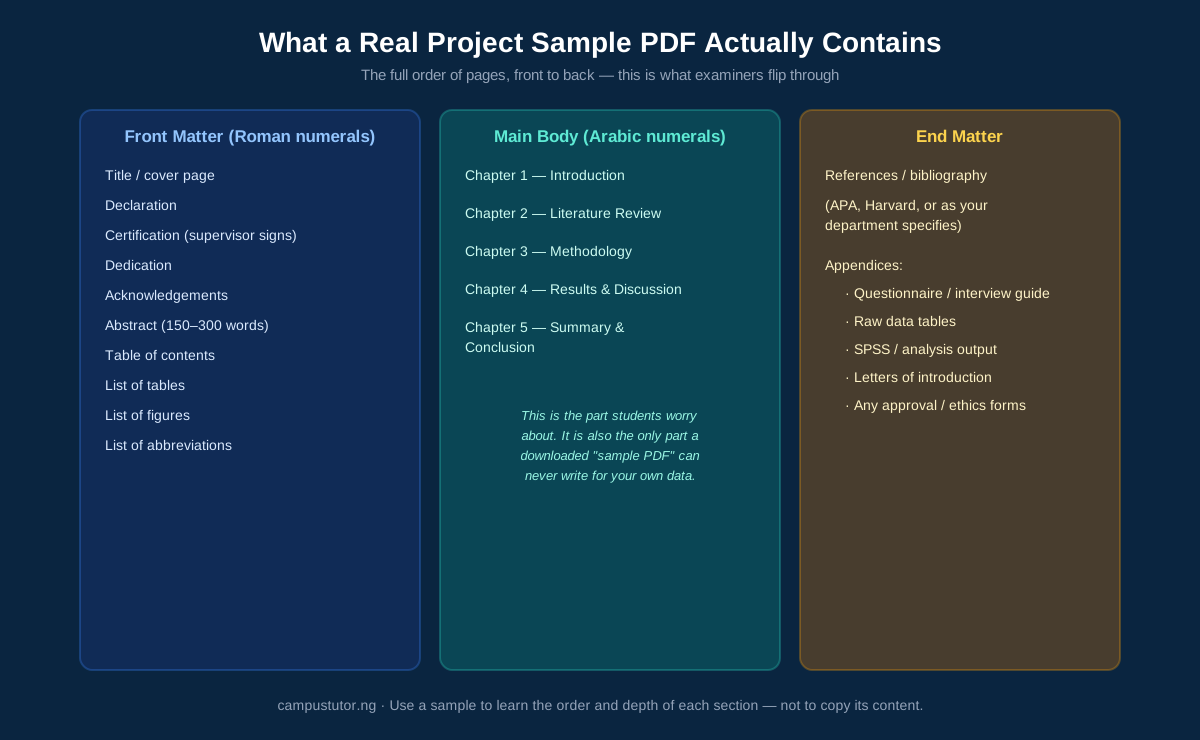
A Nigerian final year project is a single bound document, usually 50 to 120 pages, organised into three parts: the front matter (title page, abstract, table of contents and so on), the main body (five chapters), and the end matter (references and appendices). The five chapters are the part everyone worries about, but the front and end matter are where a lot of easy marks quietly get lost.
Before we go chapter by chapter, here is the whole document laid out in order, exactly as an examiner flips through it.
What is the format of a final year project?
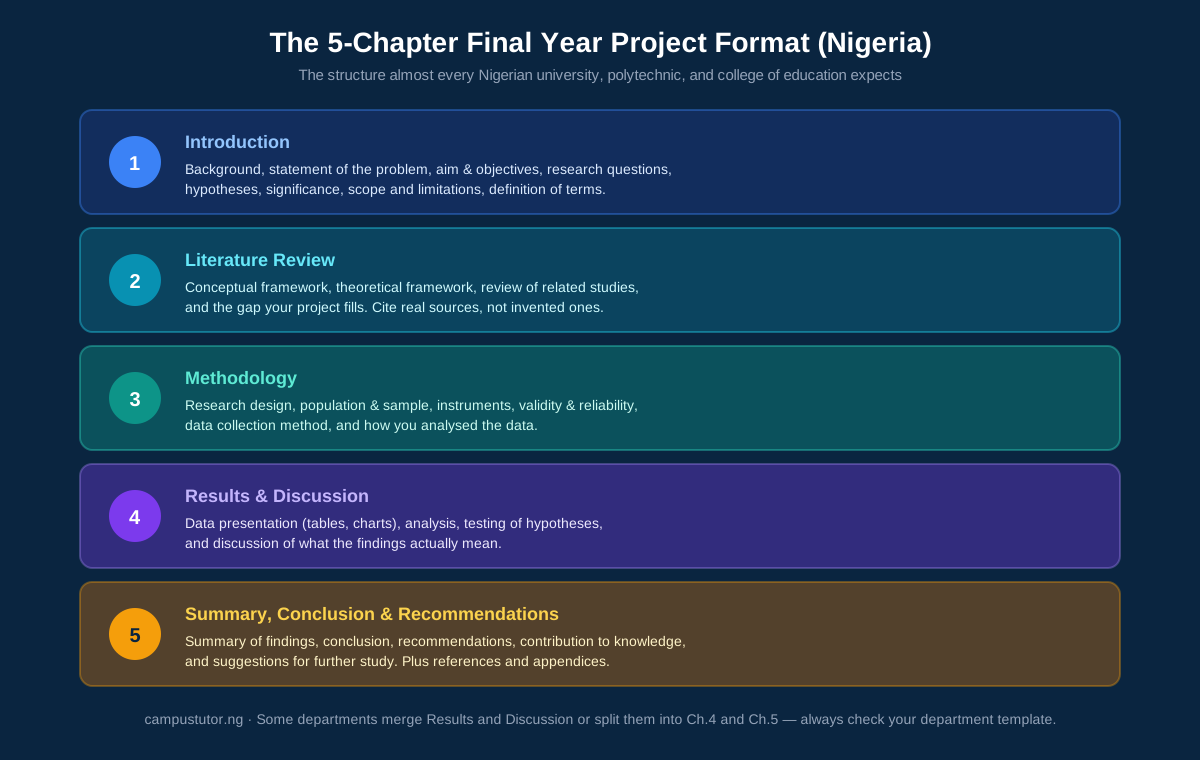
The heart of the document is the five-chapter structure. This is the part that is genuinely standardised across Nigerian institutions. Some departments split or merge a chapter (more on that below), but if you build around these five, you are on solid ground.
Chapter One: Introduction
Chapter One sets up the entire project. It tells the reader what you are studying, why it matters, and exactly what you intend to find out. It is also the chapter you will rewrite the most, because as your project develops, your understanding of your own problem sharpens. Most departments expect these sub-sections:
- Background to the study: the wider context, narrowing down to your specific issue.
- Statement of the problem: the single most important paragraph in your project. State clearly what is wrong, missing, or unresolved that your study addresses.
- Aim and objectives: one aim (the big-picture goal) and three to five specific objectives that each start with a verb (examine, determine, assess, evaluate).
- Research questions and/or hypotheses: the questions your project answers, usually one per objective.
- Significance of the study: who benefits and how.
- Scope and limitations: the boundaries — your location, your sample, your time period, and what you deliberately leave out.
- Definition of terms: any technical or local terms a reader outside your field would need defined.
Chapter Two: Literature Review
Chapter Two is where students panic the most and pad the most. It is not a summary of everything ever written on your topic. It is a guided tour of the existing research that ends by showing the gap your project fills. A strong literature review has three movements: a conceptual framework (defining and discussing your key concepts), a theoretical framework (the established theory your work sits on), and a review of related studies (what other researchers found, and where they disagree or fall short).
The single rule that matters here: cite real sources. Examiners in 2026 routinely check references, and a fabricated citation, the kind AI tools love to invent, can sink an otherwise good project. If you are pulling literature together, do it from sources you have actually opened.
Chapter Three: Methodology
Chapter Three explains how you did the study, in enough detail that another researcher could repeat it. This is the chapter the defence panel digs into hardest, because it is where they can tell whether you actually understand your own work. Expect to cover your research design (survey, experimental, case study, qualitative), your population and sample (who you studied and how you selected them), your instruments (questionnaire, interview guide, lab procedure), how you established validity and reliability, your data collection procedure, and your method of data analysis (the specific statistical or qualitative technique).
Chapter Four: Results and Discussion
Chapter Four presents what you found and what it means. First you present the data, usually in tables and figures with a sentence or two of explanation each. Then you analyse it: test your hypotheses, answer your research questions, and discuss how your findings line up with (or contradict) the studies you reviewed in Chapter Two. The discussion is what separates a project that earns a good grade from one that just reports numbers. Anyone can paste an SPSS table. Telling the reader why the numbers came out that way is the actual work.
Chapter Five: Summary, Conclusion and Recommendations
Chapter Five closes the loop. It summarises your findings in plain language, draws a conclusion that directly answers your research questions, makes practical recommendations based on what you found, states your contribution to knowledge, and suggests areas for further study. It is short, often the shortest chapter, but a weak Chapter Five undoes a strong project, because it is the last thing the examiner reads before deciding on your grade.
Does every Nigerian institution use the same format?
Mostly, yes, but watch for local variations. Some science and engineering departments split Results (Chapter Four) and Discussion (Chapter Five) into separate chapters, pushing the conclusion to Chapter Six. Some polytechnics running ND projects expect a slimmer four-chapter version. Colleges of education sometimes have their own NCCE-influenced template. The five-chapter structure is the national default, but your department's official project guideline always wins.
- Collect your department's official project format guideline before you write anything. Most departments have a printed or PDF template — ask your supervisor or the project coordinator.
- Ask to see two or three past projects from your own department that scored well. The format details (margins, citation style, binding colour) are department-specific and these examples settle every formatting argument.
- Confirm the citation style your department uses — APA is the most common in Nigeria, but Harvard and numbered styles appear too.
- Confirm the required word count or page range, line spacing (usually 1.5 or double), and font (usually Times New Roman 12).
Where can I find a final year project sample PDF?
This is the search that brought a lot of readers here, so let us be straight about it. There are thousands of full project work sample PDFs floating around Nigerian project sites, and looking at one is genuinely useful, for studying the format. The places students usually find them:
- Your institution's library or digital repository — the best source, because these samples match your exact department format.
- Past students in your department — ask seniors who graduated with a good grade.
- Open academic repositories such as your university's e-library, and global ones like CORE, OpenAlex, and institutional repositories that index Nigerian theses.
- Commercial Nigerian project websites — abundant, but the quality varies wildly and many recycle the same documents across thousands of "unique" titles.
If you want the honest economics of paying someone to write it instead, including what it costs and why students lose at the defence, we covered that fully in our guide to thesis writing services in Nigeria.
How do I turn this format into a finished project?
Knowing the format is step one. The students who actually finish do something simple: they treat each sub-section as its own small writing task instead of trying to write a whole chapter in one sitting. "Write Chapter Two" is paralysing. "Write the conceptual framework, about 600 words, today" is doable before lunch.
It also helps enormously to start from an approved proposal, because a good proposal already contains the bones of Chapter One and a plan for Chapter Three. If you have not written yours yet, our walkthrough on how to write a final year project proposal takes you from a rough topic to a proposal your supervisor will actually approve.
A final year project is not a writing test. It is a thinking test, dressed up in five chapters. The format is just the costume. The thinking has to be yours.— CampusTutor Editorial
Share this article