Ask any Nigerian final year student which chapter gave them the most trouble and most will say the same thing: Chapter One. Not because it is the longest, it usually is not, but because it is the chapter you write first, before you fully understand your own project, and the chapter you rewrite the most as your understanding sharpens. It is also the chapter your supervisor reads most carefully, because a vague Chapter One signals a vague project.
The good news is that Chapter One, the introduction, is the most templated part of the whole project. It has a fixed set of sections that appear in nearly every Nigerian department, in nearly the same order. Once you know what each section is actually for, writing it becomes a matter of filling in your specific study, not inventing structure from scratch. This guide goes through every section, with a running example you can adapt.
What goes into the introduction of a final year project?
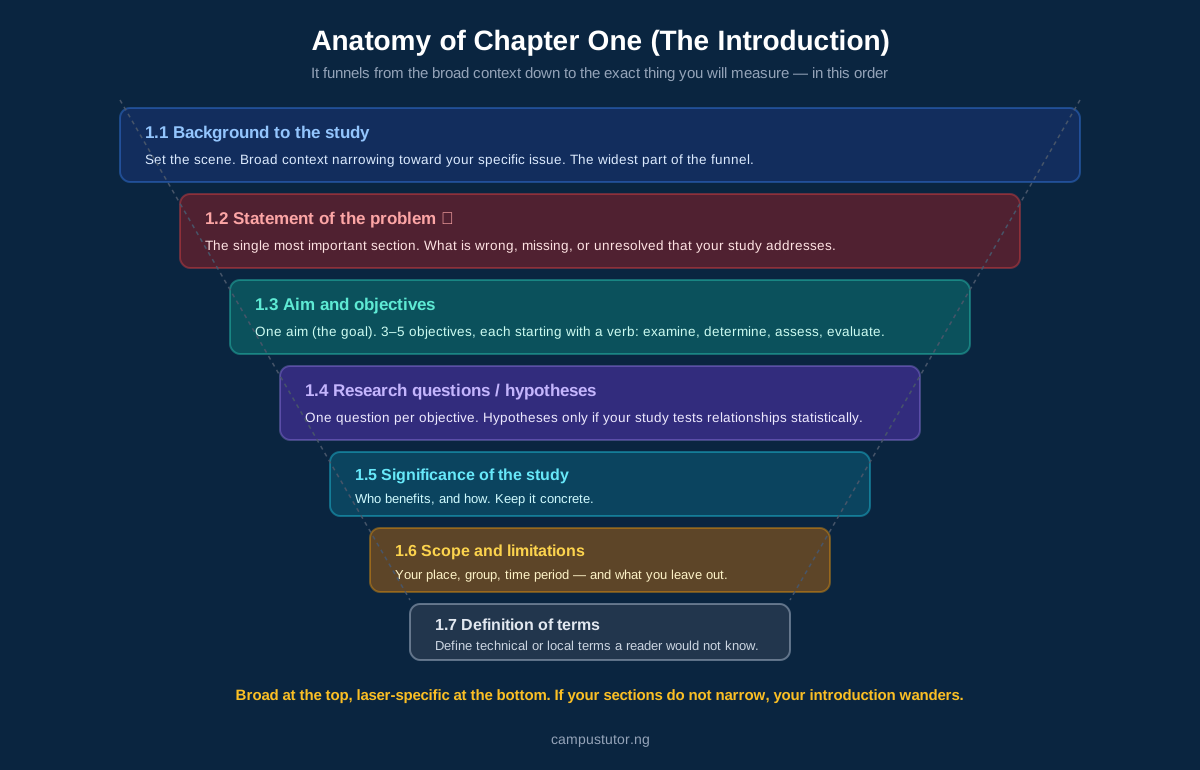
Think of Chapter One as a funnel. It starts wide, with the broad context of your topic, and narrows section by section until it reaches the single, specific thing you are going to measure. If your sections do not narrow in that order, the introduction reads like it is wandering, and that is the most common reason supervisors send Chapter One back.
Background to the study
The background sets the scene. You start broad, with the wider context your topic sits in, and narrow toward your specific issue over a few paragraphs. The mistake students make here is starting too broad, "Since the beginning of time, communication has been important to mankind" is the kind of opening that makes supervisors sigh. Start close to your actual topic. If you are studying mobile money among market traders, open with the recent growth of mobile money in Nigeria, not with the history of money itself.
Statement of the problem
This is the single most important section in your entire project. The statement of the problem says, clearly and directly, what is wrong, missing, unresolved, or not yet understood, that your study addresses. It is not a summary of your topic. It is the gap. Everything else in your project exists to respond to this section.
A strong statement of the problem usually does three things: it states what is currently known or assumed, it points to what is still missing or contradictory, and it explains why that gap matters. Keep it tight, often half a page to a page, and resist the urge to pad it with general background. The background already did that job.
Aim and objectives
Here students trip over the difference between an aim and objectives, so be precise. The aim is the single big-picture goal of your study, stated in one sentence. The objectives are the three to five specific, concrete steps you will take to reach that aim. Each objective should start with a measurable verb, examine, determine, assess, evaluate, identify, compare, never a vague one like "understand" or "know," because you cannot demonstrate that you understood something in your results chapter.
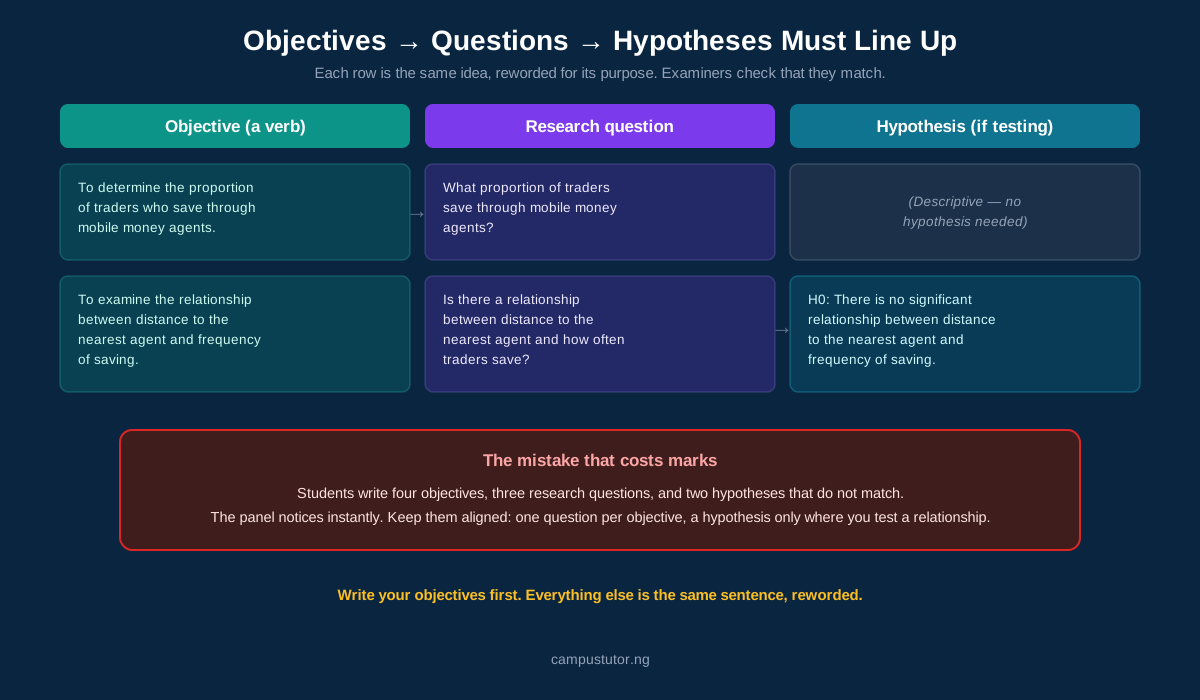
- Aim (one sentence): "To examine how the presence of mobile money agents affects the savings habits of petty traders in [named market]."
- Objective 1: "To determine the proportion of traders who save through mobile money agents."
- Objective 2: "To examine the relationship between distance to the nearest agent and frequency of saving."
- Objective 3: "To identify the main barriers traders report to saving through mobile money."
Research questions and hypotheses
Your research questions are simply your objectives rephrased as questions, usually one question per objective. Hypotheses come in only if your study tests a relationship statistically, in which case you state them (often as a null hypothesis, H0) for the objectives that involve testing. A purely descriptive objective does not need a hypothesis. This is the section examiners check hardest for alignment, because misalignment here is the clearest sign a student did not plan their project.
Significance of the study
This section answers: who benefits from this study, and how? Be concrete and name real beneficiaries, the traders themselves, mobile money providers deciding where to place agents, policymakers, future researchers. Avoid the empty version every supervisor has read a thousand times: "This study will be significant to students, researchers, and the general public." That sentence says nothing. Name specific groups and specific benefits.
Scope and limitations
The scope draws the boundaries of your study: the place, the group, the time period, and the aspects you are deliberately not covering. Limitations are the honest constraints, a small sample, a single location, a short data-collection window. Stating limitations does not weaken your project; pretending you have none does. Examiners respect a student who knows exactly what their study can and cannot claim.
Definition of terms
The narrowest part of the funnel. Define any technical, theoretical, or local terms a reader outside your field would not immediately understand, and define them as you use them in your study, not just the dictionary meaning. If "mobile money agent" has a specific meaning in your work, say so here.
How long should Chapter One be?
For a Nigerian undergraduate project, Chapter One is typically eight to fifteen pages, though your department guideline is the final word. It is usually the second-shortest chapter after the conclusion. If your Chapter One is creeping toward twenty-five pages, you are almost certainly padding the background or smuggling literature review material into it. The detailed discussion of other studies belongs in Chapter Two, not here.
For how the rest of the document is structured and how long each chapter runs, see our full breakdown of the final year project format.
Should I write Chapter One first?
You write Chapter One first in the sense that it comes first in the document, but you should not write it cold. The smart sequence is to get your proposal approved first, because an approved proposal already contains a draft of almost every Chapter One section, then expand each section into its full form. Many students who feel stuck on Chapter One are really stuck because they skipped the proposal stage and are trying to invent the structure and the content at the same time.
If you have not written your proposal yet, start there, our guide on how to write a final year project proposal walks you through it. And expect to revise Chapter One more than once. As your literature review deepens and your data comes in, your statement of the problem and objectives will get sharper. That is normal. Almost nobody's Chapter One survives unchanged to the final submission.
A strong Chapter One is not the one with the most pages. It is the one where a stranger could read the statement of the problem and tell you exactly what the rest of the project is going to do.— CampusTutor Editorial
Share this article