
Campus tutoring services are one of the most talked-about but least understood advantages available to Nigerian undergraduates. Students will spend thousands of naira on photocopied handouts, roadside textbooks, and JAMB prep materials before they consider that the most effective academic support, personalised tutoring on the exact topics they are struggling with, is often sitting right on their campus or on their phone.
This guide maps out the full landscape of campus tutoring services for Nigerian university and polytechnic students. It covers what each type costs, what it is actually good for, and how to tell whether a particular service is worth your time and money.
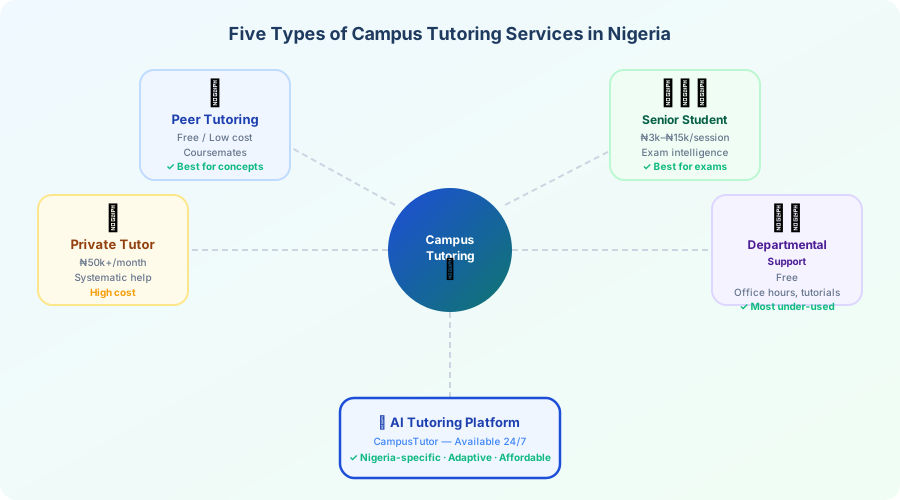
The five main types of campus tutoring services
Not all tutoring services work the same way or solve the same problem. Understanding which category fits your situation is the first step to finding the right support.
1. Peer tutoring
Peer tutoring is when a classmate who has understood a concept explains it to someone who has not. It is the most common form of campus tutoring in Nigeria and, in many cases, the most effective one, because the peer tutor recently sat exactly where you are sitting and understands the specific sticking points in the material.
Peer tutoring is usually free or very low cost. It is especially valuable in courses with high theoretical density where the language of explanation matters as much as the content itself. A coursemate who struggled with the same concept last week often explains it better than a lecturer who has not been a student for twenty years.
2. Senior student tutoring
Senior student tutoring is structurally similar to peer tutoring but with one important advantage: the senior student has already sat the exam you are preparing for. They know which question formats your lecturer uses, which topics have come up in the past three years, and what the marking scheme actually rewards. That exam-specific knowledge is not something a general private tutor can replicate.
Senior student tutors typically charge between three thousand and fifteen thousand naira per session depending on the subject, the institution, and the level of the course. For high-stakes courses where a carryover would cost you a full semester, this is usually a strong return on investment.
3. Private tutors
Private tutors are usually postgraduate students, recent graduates, or working professionals who offer subject tutoring at a higher price point. They are the right choice when you need sustained, systematic help across a course rather than a one-off session to clear a specific confusion. Private tutors are most common in Lagos, Abuja, Ibadan, and other cities with large student populations.
The honest limitation is cost. Monthly private tutoring across two or three subjects can easily exceed fifty thousand naira, which is not realistic for most undergraduates on a typical student budget. AI tutoring services are steadily closing that gap for students who cannot afford private rates.
4. Departmental academic support
Many Nigerian university departments offer formal or informal support that most students never use. Tutorial classes, supplementary lectures, and lecturer office hours exist in most faculties. The uptake is consistently low, which means the students who do show up face almost no competition for their lecturer's time.
If your department runs tutorial classes as part of the course structure, treat them as mandatory even when attendance is technically optional. These are often the sessions where exam-relevant examples get worked through in detail.
5. AI-powered tutoring platforms
AI tutoring platforms are the newest and fastest-growing category of campus tutoring services in Nigeria. The best ones combine the accessibility of a self-study resource with the personalisation and interactivity of a human tutor. They are available at any hour, generate institution-calibrated practice questions on demand, and adapt their explanations based on what you have and have not yet understood.
CampusTutor is built specifically for Nigerian universities, polytechnics, and colleges of education. Rather than applying generic curriculum content, it understands the difference between studying for a University of Lagos Mathematics exam and a Federal Polytechnic Ado-Ekiti Mathematics paper. That specificity is what separates a purpose-built AI tutoring platform from asking a general chatbot to explain your coursework.
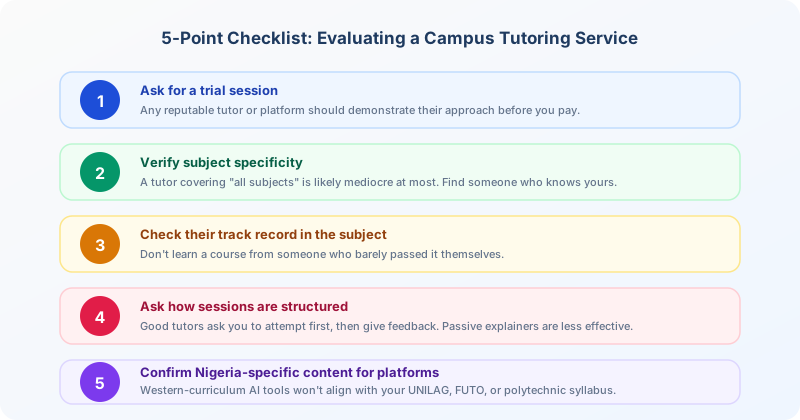
How to evaluate a campus tutoring service before you pay
Whether you are paying a senior student for a session or subscribing to a platform, evaluating quality before you commit saves both time and money.
- Ask for a trial session. Any reputable tutor or platform should be able to demonstrate their approach with a short sample before you pay for a full engagement.
- Check subject specificity. A tutor who claims to cover all undergraduate subjects is probably mediocre at most of them. Find someone who knows your specific course well.
- Verify their own academic record. For peer and senior tutors, this is worth asking about directly. Someone who scored a C in the course you need help with is the wrong person to learn from.
- Ask how sessions are structured. Good tutors have a method. They ask you to attempt something first, give you feedback, and check your understanding before wrapping up. Tutors who just talk and move on are less effective.
- For platforms, confirm the content is Nigeria-specific. An EdTech product built for the US or UK curriculum will give you explanations that do not match how your lecturer frames the same concepts.
How the tutoring landscape differs across Nigerian institutions
The tutoring landscape varies significantly across Nigerian campuses. Larger institutions like UNILAG, UI, OAU, and UNIPORT tend to have more active peer tutoring networks, more postgraduate tutors available for hire, and more formal departmental support. Smaller institutions and polytechnics often have less formal infrastructure but equally strong informal peer networks.
Students at polytechnics and colleges of education face a specific challenge. The Nigerian EdTech ecosystem was historically designed for university students. Most platforms, YouTube channels, and tutorial services target university syllabuses. This leaves polytechnic ND and HND students and NCE students in a gap. CampusTutor explicitly supports all three institution types with calibrated content, which is part of why it has grown in those segments faster than most alternatives.
Free campus tutoring resources most students are not using
Before spending money on any tutoring service, make sure you are using the free resources your institution already provides. Most Nigerian undergraduates significantly underuse what is already available to them.
- Your university library, physical and digital. Databases like JSTOR and HINARI (free for Nigerian students in health sciences) are legitimate free academic resources that most students ignore entirely.
- Lecturer office hours. The most underused free tutoring resource on every Nigerian campus. Fifteen minutes with the person writing your exam is worth more than three hours with a peer tutor.
- CampusTutor's free tier. It includes AI tutoring across core courses, GPA tracking, and basic exam practice. For many students, this alone is enough to get through exam season.
- Study groups. Informal, free, and evidence-backed. A group of five students who each teach one topic to the others will consistently outperform five students studying alone.
- Past questions from the library or your department. Most departments have examination papers going back several years. They are free, they show you exactly what the exam looks like, and most students never bother to collect them.
When paying for campus tutoring services makes sense
Paid campus tutoring services are worth the investment in specific situations. Knowing when those situations apply helps you make a rational call rather than spending money out of panic.
- You are failing or close to failing a core course and a carryover would delay your graduation.
- You have a specific knowledge gap in a high-credit course that is pulling your CGPA below the classification you are targeting.
- You have tried to understand something independently across more than two sessions without a breakthrough. That is the right moment to bring in outside support.
- You are preparing for a competitive exam, such as postgraduate entrance or a professional certification, where the stakes justify a higher investment.
- Your semester workload is genuinely heavy and self-study alone is not keeping up. A structured tutoring schedule with regular deadlines creates accountability that reading alone cannot.
Building your personal campus tutoring plan
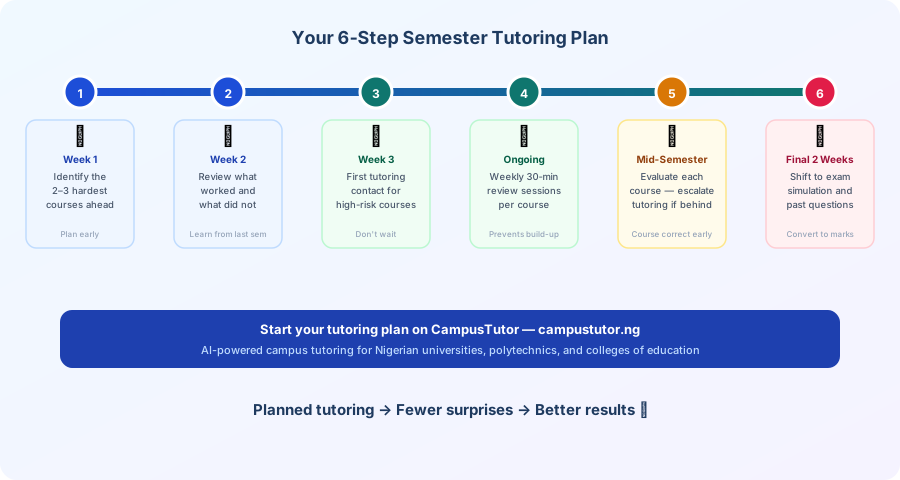
The students who benefit most from campus tutoring services are the ones who treat it as a semester-long strategy rather than a reactive scramble. Here is a practical framework for building your tutoring plan at the start of each semester.
- In week one, identify the two or three courses coming up that historically give students in your department the most trouble.
- In week two, be honest about what worked last semester and what did not. The goal is to start strong before falling behind, not to recover from weakness.
- In week three, arrange your first tutoring contact for any high-risk course. This could be a study group, a conversation with a senior student, or your first CampusTutor session on the topic.
- Build weekly review sessions into your timetable. Thirty minutes per course per week reviewing what you covered with a tutor is what stops small misunderstandings from becoming exam-week disasters.
- At the midpoint of semester, check your progress in each course. If anything is below where it should be, increase the tutoring before the damage becomes hard to reverse.
- In the final two weeks before exams, shift from concept building to exam simulation. Use past questions, timed practice, and AI-powered exam simulation to turn understanding into actual marks.
A word on campus tutoring and academic integrity
People sometimes wonder whether getting tutoring help counts as a breach of academic integrity. It does not. Tutoring is legitimate academic support. It is exactly what happens in every tutorial class, during every lecturer office hour, and in every formal mentorship programme at every Nigerian university. Using a tutor, whether human or AI, to understand material better is not cheating. Paying someone to write your assignment for you, or submitting AI-generated work as your own without disclosure, is a different thing entirely.
The distinction is about who does the thinking. Tutoring helps you think more clearly about the material. Ghostwriting outsources the thinking altogether. One builds the understanding your degree is supposed to certify. The other produces a certificate with nothing behind it.
The bottom line on campus tutoring services in Nigeria
Campus tutoring services are not a crutch for students who are struggling. They are what serious students use to turn average results into strong ones, and strong results into exceptional ones. The most successful Nigerian graduates, the ones collecting first class degrees and strong second class upper results from competitive departments, are almost always the ones who supplemented formal teaching with deliberate academic support throughout their degree.
The landscape has never been more accessible. Peer networks, senior student tutors, departmental support, and AI-powered platforms like CampusTutor together give every Nigerian undergraduate access to the kind of personalised help that was once reserved for students at the most well-resourced private universities. The difference between students who use it and students who do not is not ability. It is awareness and the intention to act.
The single most expensive academic mistake a Nigerian student can make is reaching week twelve before asking for help with a course they have been struggling with since week three.— CampusTutor Editorial
Share this article