
Walk into any Nigerian university at the start of exam season and you will notice something has shifted. Students who coasted through the first ten weeks are suddenly in a panic. Lecture notes from January are being read for the first time. WhatsApp groups are flooded with last-minute questions. And then there are the students who are quietly calm, the ones who do not look like exam season has derailed their lives. They almost always have one thing in common: they did not wait until the last moment to get help. Campus tutoring is the reason many of them are calm right now.
This guide covers every dimension of campus tutoring that matters for Nigerian undergraduates: what it is, why it works, how to find it, and how to squeeze the most value out of it whether you are at a university, polytechnic, or college of education.
What campus tutoring actually means
Campus tutoring is any structured academic support that happens outside the formal lecture or seminar setting. In Nigeria, it takes several forms. The most traditional is peer tutoring where a student who has already mastered a course explains it to others, usually for a small fee or in exchange for help with a different subject. Senior student tutoring is a close cousin; a 300 level student teaching first year material they passed two years ago.
Then there is the newer category that is reshaping how campus tutoring works in Nigeria: AI powered tutoring. Platforms like CampusTutor deliver institution-specific tutoring on demand at any hour, in a format that adjusts to exactly where you are struggling right now. The core principle is the same as face-to-face peer tutoring — personalised, back-and-forth explanation until the concept clicks. What is different is the availability.
Why campus tutoring actually works
Campus tutoring works for reasons that are well established in cognitive psychology. Understanding those reasons helps you get far more out of every session.
The first reason is retrieval practice. When a tutor asks you to explain a concept back, you are doing active recall — pulling information out of your memory rather than passively reading it in. Every successful retrieval strengthens the memory trace. Every failed retrieval shows you exactly where the gap is. That is the mechanism that makes tutoring more effective than rereading for most students.
The second reason is immediate error correction. In a lecture theatre of two hundred students, you cannot stop and ask the lecturer to explain that step again. In a tutoring session, whether with a peer or an AI platform, you can ask as many times as it takes. The moment you misunderstand something, it gets corrected before it has time to harden into a wrong mental model that takes twice as long to fix later.
The third reason is what researchers call the protégé effect, and it applies specifically to peer tutoring. When you act as the tutor and explain a concept to someone else, your own understanding deepens significantly. If you are a strong student and you tutor others, you are not doing them a favour at your own expense. You are reinforcing your own mastery at the same time.
How to find campus tutoring at a Nigerian university
The best campus tutoring networks in Nigeria are informal and driven by word of mouth. Here is where to look.
- Your department noticeboard. Many senior students post tutoring availability at the start of semester, especially in high-demand courses like Calculus, Organic Chemistry, and Financial Accounting.
- Faculty WhatsApp groups. Every Nigerian department has at least one unofficial class group. Post that you are looking for help with a specific course. You will usually get two or three responses within a day.
- The academic affairs office of your Students Union. Some universities run formal peer tutoring schemes through the union.
- CampusTutor. Available on your phone, calibrated to Nigerian university curricula, and accessible at eleven at night during exam week when your senior student is unavailable.
- Your lecturers office hours. Underused by almost every Nigerian undergraduate, office hours are free tutoring straight from the person setting your exam.
Which subjects benefit most from campus tutoring
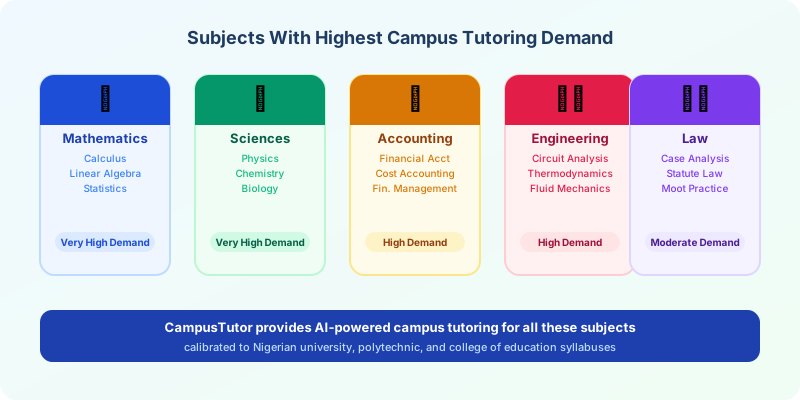
Not every subject responds equally to tutoring. The courses where campus tutoring consistently produces the biggest jump in performance are the ones with a high procedural component. You do not just need to understand the concept. You need to practise applying it under pressure, and that is exactly what a good tutoring session forces you to do.
- Mathematics and Statistics: Calculus, Linear Algebra, Probability, Quantitative Methods. Procedural mastery here needs worked examples, not just reading.
- Physical Sciences: General Physics, Physical Chemistry, Thermodynamics. One worked derivation with a tutor is often worth more than two hours of reading lecture notes.
- Accounting and Finance: Financial Accounting, Cost Accounting, Financial Management. Tutors who have sat the same exams know which question formats appear most often.
- Engineering courses: Circuit Analysis, Structural Analysis, Fluid Mechanics. The mix of mathematical technique and conceptual understanding is exactly where peer tutors add value.
- Law: Tutorial discussion of case law and statute application is the traditional format in Law faculties, and it works.
How to get the most out of a tutoring session
Most students who fail to benefit from campus tutoring are making one of a small number of predictable mistakes. Knowing what they are lets you avoid them.
- Come with a specific question, not vague confusion. "I do not understand chapter five" is not something a tutor can work with. "I cannot figure out why my answer to this integration problem differs from the mark scheme" is.
- Attempt the problem before the session. A student who arrives having tried and failed is infinitely easier to help than one who has not tried at all. The attempt shows exactly where the thinking breaks down.
- Ask for the why, not just the how. Knowing the next step is less useful than understanding why you use this approach for this type of problem. The why is what transfers to exam questions you have never seen before.
- Teach it back. At the end of any tutoring explanation, close your notes and explain the concept back in your own words. If you cannot do it, the session is not done yet.
- Schedule sessions early, not just before exams. A session in week seven of semester is far more useful than the same session in week fourteen because there is still time to practise what you learned.
Campus tutoring versus self-study: knowing when to use each
Campus tutoring and self-study are not competing approaches. They are complementary phases of the same learning cycle, and knowing when to switch between them is what separates efficient students from ones who spend a lot of hours studying without making much progress.
Self-study is the right format for building initial familiarity with new material, reading lecture notes, attempting problems on your own, and reviewing what you have already learned. Campus tutoring is the right format for clearing confusion that self-study has not resolved, practising worked examples with feedback, and building confidence before an exam.
A practical rhythm that works well for Nigerian university students: read and attempt things independently first. When you hit a problem you genuinely cannot crack after two real attempts, that is your signal to bring it to a tutoring session. After the session, go back to independent practice and apply what you learned before your next session.
AI tutoring and what it means for campus tutoring in Nigeria
AI tutoring platforms are changing what campus tutoring looks like in Nigeria. The old constraints of finding a senior student in your subject, coordinating schedules, and paying a fee you might not afford are disappearing. AI tutoring is available at any hour, costs less than a textbook subscription, and never gets impatient when you ask the same question three times.
AI tutoring is exceptionally good at explaining concepts at different depths, generating worked examples on demand, testing your understanding through questions, and tracking which topics you consistently struggle with. What it does not replace is the human side of studying with peers, the accountability of a study group, and the mentorship a senior student can offer about navigating your specific department.
Campus tutoring for polytechnic and college of education students
Campus tutoring is not only for university students, and the need for it is often sharper at polytechnics and colleges of education. Polytechnic programmes are more practically oriented and rely heavily on continuous assessment, which means a knowledge gap in a technical course can build up quietly through the semester and become a serious problem close to graduation.
For NCE students specifically, the subject knowledge demands of Teaching Practice preparation are real. A student who is shaky on their subject matter will struggle to deliver a convincing TP lesson. Whether you get tutoring help from peers in your subject combination or from CampusTutor's AI, clearing those gaps before your supervisor visit is one of the most useful things you can do.
Campus tutoring is a long game, not a last resort
The students who benefit most from campus tutoring are not the ones who use it as a rescue operation the week before exams. They are the ones who build it into their semester rhythm from week three or four. A tutoring session in October that clears up a confusion in Thermodynamics means that confusion does not become a six-week blind spot that costs you marks in November.
Think about it the same way you think about going to the campus clinic. You go when something is wrong and you want to fix it before it gets worse, not after you have been sick for a month and the exam is in two days. The earlier you engage with academic support, the more value you get for the same amount of time.
The student who asks for help in week six is solving a problem. The student who asks in week fourteen is managing a crisis.— CampusTutor Editorial
Share this article